
Benchmark stock indices Sensex and Nifty closed higher on Thursday, helped by a rally in blue-chip Larsen & Toubro and the Economic Survey projecting the GDP growth of 6.8-7.2 per cent for the next fiscal.

India's rapidly ageing truck fleet, with 42% of vehicles over 12 years old, is set to trigger a replacement-driven growth of 3-5% annually over the next five years.

Crude oil prices experienced a significant drop following the announcement of a US-Iran ceasefire and the reopening of the Strait of Hormuz, leading to heavy selling by traders.

Domestic automobile retail sales in India experienced a significant surge of 26 per cent year-on-year in February, driven by improved affordability and market confidence across various segments, according to FADA.

Fitch Ratings on Monday affirmed India's sovereign rating at 'BBB-', with a stable outlook, saying a strong record of delivering growth and improving fiscal credibility will drive improvements in structural metrics. "India's ratings are supported by its robust growth and solid external finances," Fitch said, as it forecast GDP growth of 6.5 per cent in the fiscal year ending March 2026 (FY26), unchanged from FY25, and well above the 'BBB' median of 2.5 per cent.

West Asia conflict triggers sharp sell-off in Indian markets, with realty, banking and auto stocks leading losses amid energy shock fears.

Gold prices are likely to trade firm next week as traders await key economic data, including US inflation numbers, for fresh cues on interest rate outlook, while silver may remain volatile amid shifting risk sentiment and speculative activity, analysts said.
Deloitte India on Thursday projected India's economy to grow 6.7-6.9 per cent in the current fiscal amid buoyant demand and policy reforms. Indian economy grew 7.8 per cent in the April-June quarter of current fiscal.

'She was not a yes person. She would tell the truth and her feelings to Indira Gandhi, and Indira Gandhi would value her opinion. The same was the case with Rajiv Gandhi who would value her opinion.'

While Goldman Sachs says India will see a transition, HSBC feels structural imbalances will lead to cloudy outlook for markets.

'We are profoundly energy-dependent on the Gulf. That dependency must now be redirected towards the United States, because we require American permission to procure oil.' 'We additionally require Iranian permission to acquire oil from that source. So India now has to seek two separate permissions merely to secure its energy supply.' 'Should we be compelled to source from America, or from Venezuela -- which is, in effect, American-controlled supply -- that will inevitably carry a price premium, an elevated shipping cost, and a considerably extended delivery timeline, given the distances involved.'

The purge in Washington does not pause the war. Strikes continue, Hormuz remains closed, and Brent crude is still dancing around $109 a barrel. For India, the command chaos in the Pentagon is another layer of uncertainty piled on five weeks of conflict that was already straining every buffer Delhi has.

Silver and gold prices declined sharply in the futures trade on Friday as traders booked profits at elevated levels after a record-breaking rally, tracking a bearish sentiment in global markets and a rebound in the US dollar.

The dollar moved higher, while prices for US government debt fell, as traders ramped up bets the Federal Reserve would raise interest rates in March

India's equity markets may have expanded rapidly, but initial public offerings (IPOs) are increasingly becoming exit vehicles for early investors rather than as engines for raising long-term capital, a shift that undermines the spirit of public markets, Chief Economic Advisor V Anantha Nageswaran warned on Monday at a CII event.

Capex, infrastructure development, and prudent fiscal management are the key focus areas in the Budget, says Nilesh Shah.

The recent correction suggests that while precious metals hedge geopolitical tension and inflation, they are not immune to sharp short-term corrections and profit-booking.

From the Sensex firms, Tata Steel tanked the most by 4.57 per cent. ICICI Bank, Power Grid, HCL Tech, Tech Mahindra, Infosys and Kotak Mahindra Bank were also among the laggards. Mahindra & Mahindra, State Bank of India, ITC and Bharat Electronics were among the gainers.

India's macroeconomic health is in a "relative goldilocks situation", and although the risk of higher landed oil prices, due to insurance cost surges and closure of choke points due to the brief Israel-Iran war, has receded, it is "too soon to sound the 'all clear' for the rest of the year", the Finance Ministry said on Friday.

India is projected to grow at 6.4 per cent in fiscal year 2025 and 2026, and the country's stable growth is driven by a reform momentum supporting robust consumption growth and a push for public investment, the International Monetary Fund has said. The IMF released its World Economic Outlook (WEO) Update on Tuesday.

Companies may foot less of the tax bill for some time yet. The corporate share of net direct tax collections has been lower in 2024-25 than in previous years. The corporate segment accounted for 45.6 per cent of total net direct tax collections as of March 16, compared to 48.1 per cent on the same date in 2023-24 (FY24).

'Economic activity appears to have peaked in the second quarter of FY26, with industrial output, exports, and business confidence all softening from October 2025.'

Domestic gold exchange-traded funds (ETFs) saw their holdings jump 65 per cent to 95 tonnes in 2025, elevating Indian ETFs to sixth place globally, going by holdings of the yellow metal. At the end of 2024, they ranked eighth with 57.5 tonnes of holding, according to an analysis of data from the World Gold Council (WGC).

The prospect of protracted uncertainties in the global economic landscape not only pose a risk for India's growth outlook in 2025-26, but are also likely to dent the private sector's capital raising and investment plans, the finance ministry averred on Tuesday, cautioning the country's corporates that the era of 'easy pickings' was over.

The Budget emerges as a measured, credible and forward-looking policy document that reinforces India's commitment to remaining a stable, reform-oriented economy amid an increasingly fragmented global landscape, says A Balasubramanian.

The heightened global uncertainty due to the US "reciprocal tariffs" on India may cause near-term corrections and market turbulence, but the long-term outlook remains constructive, market experts said on Thursday. The US has announced 27 per cent reciprocal tariffs on India, citing high import duties imposed by New Delhi on American goods.

The reduction in the goods and services tax (GST) rates has increased the momentum in India's economic activity both on the supply and demand sides, while robust agricultural activity - reflected in the strong onset of rabi sowing and adequate reservoir levels - has reinforced the outlook for food supply and rural incomes, the finance ministry said on Thursday.
Silver prices rallied sharply by Rs 15,000 to hit a lifetime high of Rs 265,000 per kg in the national capital on Monday, and gold advanced to a fresh record of Rs 144,600 per 10 grams, mirroring strong gains in the global markets.

Deloitte on Thursday projected economic growth at 6.5-6.7 per cent for the current fiscal, as tax incentives provided in the Budget are expected to push domestic demand amid an uncertain global trade environment. Deloitte estimated India's GDP growth at 6.3-6.5 per cent for FY25 and said that the economic outlook for FY26 hinges on a delicate balance between evolving trade relations and government efforts to boost domestic consumer demand.

Fitch Ratings on Wednesday raised India's GDP growth forecast to 6.9 per cent for current fiscal year, from 6.5 per cent earlier, citing strong June quarter growth and domestic consumption-led demand.

Housing sales fell 1 per cent last year to over 3.48 lakh units across eight major cities, with demand stagnating amid an average price rise of up to 19 per cent, according to Knight Frank. In a virtual press conference on Wednesday, real estate consultant Knight Frank India noted that the decline in interest rates on home loans, strong economic growth and lower inflation were some of the key factors that helped in sustaining the housing demand during the 2025 calendar year despite fears of an impending correction.

Is the parabolic rise in silver running out of steam or just getting started? Ramalingam Kalirajan offers his take on if you should invest in silver now?

New Delhi will substantially reduce tariffs on industrial and agricultural goods while continuing to protect sensitive sectors. Tariffs on some agricultural products that are not traditionally considered sensitive will be brought down to zero, while in the case of relatively sensitive items, duties will be reduced in a graded manner and quotas will be imposed.

Macroeconomic data, global market trends and trading activity of foreign investors will be the key drivers for dictating market sentiment this week, analysts said. "This week, volatility may increase ahead of the November derivatives expiry. Domestically, markets will track several high-impact macro releases, including Q2 GDP data and industrial production.

India's services sector growth moderated in December, as the rates of expansion in incoming new work and output eased to the slowest in 11 months, and companies refrained from recruiting additional staff, a monthly survey said on Tuesday. The seasonally adjusted HSBC India Services PMI Business Activity Index fell from 59.8 in November to 58.0 in December, indicating the slowest rate of expansion since January.
A host of macroeconomic data announcements, global trends and trading activity of foreign investors would dictate investors' sentiment in the stock market this week, analysts said. Besides, auto sales data will be closely tracked, experts noted.
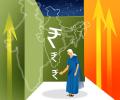
S&P Global Ratings on Wednesday upgraded India's sovereign rating outlook to positive from stable while retaining the rating at 'BBB-' on robust growth and improved quality of government expenditure. S&P said it could upgrade India's sovereign rating in the next 2 years if the country adopts a cautious fiscal and monetary policy that diminishes the government's elevated debt and interest burden while bolstering economic resilience.

India's manufacturing sector activity witnessed the weakest improvement in the sector in two years in December on account of softer expansions in new orders, prompting firms to limit input purchases and job creation, a monthly survey said on Friday. The seasonally adjusted HSBC India Manufacturing Purchasing Managers' Index (PMI) -- an indicator of sector performance -- fell from 56.6 in November to 55 in December.

Macroeconomic data announcements, global trends and trading activity of foreign investors would be major driving factors for market movement this week, analysts said. Unabated capital infusion by domestic institutional investors have supported the positive trend in the stock market last week, traders said.

Largecap equity funds remain suitable for conservative and moderate risk-taking investors seeking relatively stable returns.
